field report: building with the librarian.
My first essay argued you should keep your memory and processing local. This one shows the receipts: the field record of how I built it milestone by milestone with the lesson from each.
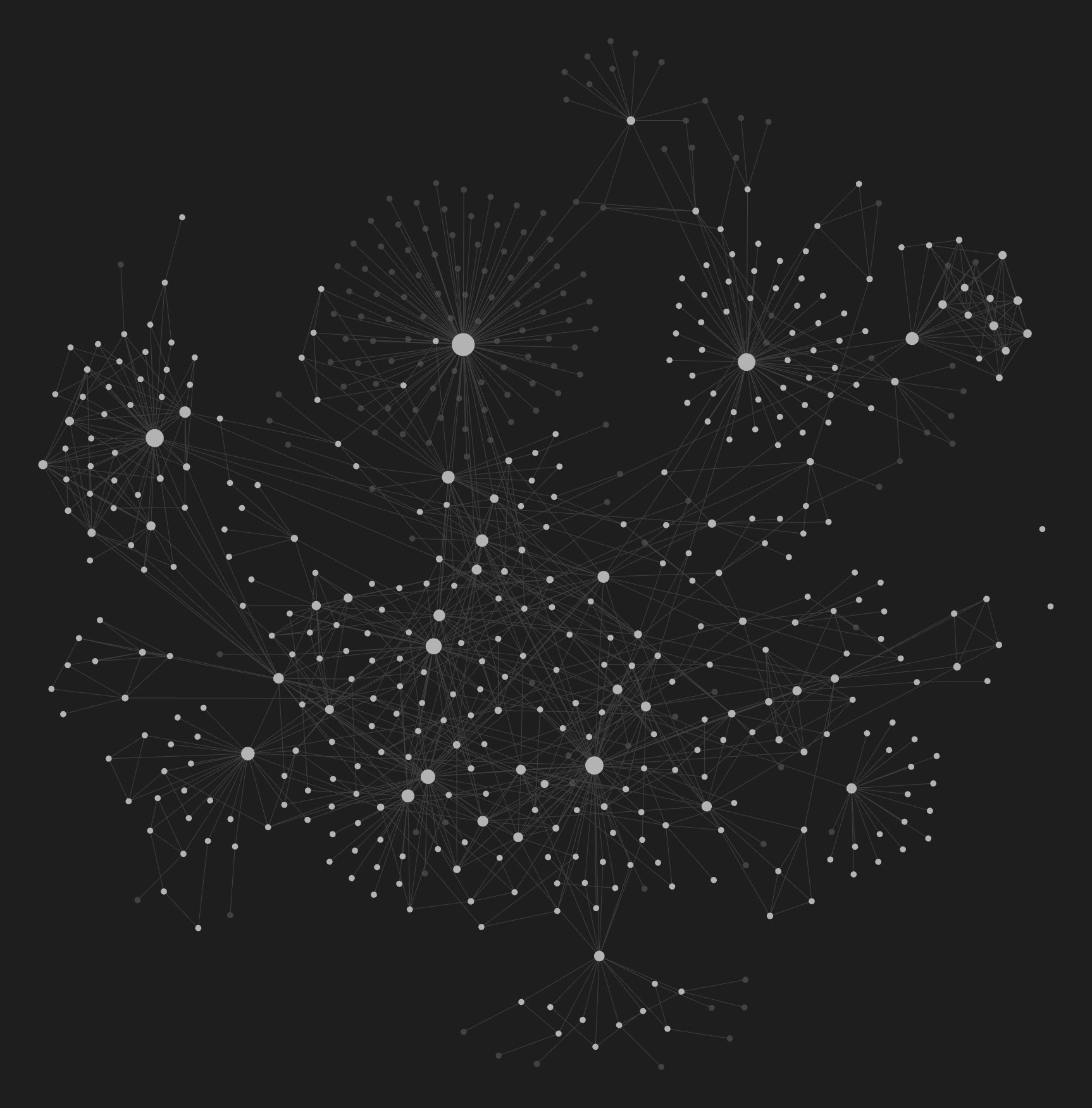
vault-graph.jpg into the /twin/ folder to show the graph here(export it from Obsidian with labels off)
Most people are still using AI as a chat window. I want to show you what happens when you stop chatting and start building. Over about two months I built a single system: one Obsidian vault, Claude Cowork given the keys to run it, two live websites and a set of rules that keep it honest. For nearly twenty years I have been a fan of mindmapping and Getting Things Done. For all that time I was the one doing the connecting and tagging and revising by hand. What changed is that the repetitive work is no longer mine. This is the field record of how I did it and why I think you can build your own.
the system is the point. without execution it fails; with it everything compounds.
the materialization · late April 2026
The vault did not really begin in April. It began years earlier in walks and notebooks and long dumps of ideas. The habit of keeping my own world in order goes back decades. April 2026 was only the month it took a form I could hold: an empty Obsidian vault, numbered sections from the inbox through to research, a daily log started on the first day. None of that was clever. It was the materialization of a mind I had been keeping for a long time. Everything since stands on it.
Remember — the boring folder discipline is what made all of this reconstructable months later. You cannot tell this story unless the system was quietly recording it from day one.
The turn came when I stopped using AI as a chat window and gave Claude Cowork the keys to the whole vault. It got a house-rules file called CLAUDE.md. The file tells it how to file a note, how to link, what voice to write in and what it must never touch. From that point the vault was no longer a notebook I kept. It was a ship with a crew. I had been the only intelligence in my mindmaps. I connected every node and updated every revision by hand. Now the repetitive part is delegated. I am left with judgement and creativity.
Remember — the leverage is not the model. It is the rules you hand it. A page of standing instructions turned a clever assistant into a reliable colleague.
8 May 2026
One dense day set a direction that still holds. I chose my own original bet over a safer one. I bought the domains. I locked the rule that governs every piece I publish: builder voice goes to dilman.tech and thinker voice goes to imbros.ai. I set the publishing convention and the posting cadence the same afternoon.
Remember — decide the splitting rules early and in writing. Months of work flowed cleanly because “which voice, which site” was never an open question again.
Two sites had to look like one mind. I refused to style them twice. Working with Claude I wrote the whole look down as a single document: exact color tokens, two typefaces and one reusable card pattern. An automated pipeline rendered the visuals instead of my hand. The first visuals were rejected twice and rebuilt three times against a sharp verbal standard rather than a vague approval. That bar is the only reason they landed fast. When the day came to redesign both sites and the articles and the social cards at once, it was a copy-and-paste job instead of four. The first deploy ran on Vercel with GitHub. Then I migrated to Cloudflare, where every push to GitHub builds the site and the world sees it. A runbook written before I needed it means I am never reconstructing how that works at the worst possible moment.
Remember — design to reuse and automate the shipping. Anything you will do more than twice belongs in a document. Put it there once as tokens and a runbook rather than carry it in your head.
Once both sites worked I tore them down to almost nothing on purpose. The rebuild is a single column of text dressed as the DEC VT320 terminal I loved during my years at Digital Equipment Corporation: amber phosphor on near-black, with four matte themes the visitor chooses and the site remembers. It was a bet that in a web full of noise restraint reads as confidence. It was also a quiet way to carry forty years of my own history into the design.
Remember — subtraction is a design decision and not a failure to add. The simpler version said more about me than the busy one did.
As the stakes rose I split the work in two so nothing went live by accident. Claude Cowork develops and verifies everything in a sandbox. The live deploy is run separately by Claude Code on my own machine, which holds the real keys. Every release passes through a build counter and an automated check before it ships. The hand that drafts is not the hand that ships.
Remember — separate drafting from shipping. The friction is the feature; it is what keeps a half-finished idea off the live site.
A system this size needs to remember its own decisions. So I gave it institutional memory. One file lists every tool the AI can reach and every gap it cannot. An append-only log records what I chose and why, newest first, so I never relitigate a settled call. Knowledge rots quietly, so a small script hunts for orphaned notes and broken links on a schedule. It runs read-only first. It reports. I approve. Only then does anything get fixed.
Remember — record decisions and not just outputs. Automate the inspection but keep the judgement human. The machine may find problems; it may not silently “fix” them.
Ideas are cheap; the discipline is what they go through. Everything starts as a raw dump into one ideas hub with no judgement at capture. Then comes the scan. The AI mines my own pasted transcripts for ideas I forgot I had. Then qualification, where each one earns a dated decision: gated, parked as feedstock, folded into another thread or killed outright. Only the survivors reach deployment as an article, a project or a short piece. Even the dead ones are kept as tombstones so I never pitch myself the same bad idea twice.
Remember — separate capturing from judging. Capture without a filter and you drown; judge at capture and you never write the dangerous thing down.
A qualified idea that wants hands becomes a project. Projects get a harder gauntlet than essays. First ideation, opening the problem wide; then the challenge, where I have the AI argue against the idea as ruthlessly as it can before I am allowed to fall in love with it; then planning, breaking the survivor into a phased spec with goals, non-goals and the explicit thing I am choosing not to build. One of my own ideas died exactly here. Its own adversarial pass killed it before it could waste a month.
Remember — make something attack the idea before you commit to it. The plan you write after surviving a real challenge is the only one worth following.
Thinking is worthless if the next action falls through the floor, so the system closes that loop. Todoist is wired in directly, so the AI can read, add and complete tasks. A plain task file in the vault keeps the human-readable list of commitments beside the work itself. Decisions made in a session turn into dated tasks automatically. That is how a stray “we should” stops evaporating and starts getting done. I have been a fan of Getting Things Done for years; this is the version where my own second brain finally does the remembering.
Remember — the same system that holds your ideas has to hold your next actions or the ideas never ship. A second brain that cannot remind you of anything is just a nicer drawer.
The most personal writing I do never ships as written. Public pieces run through a redaction pass: family names softened, health and financial detail removed, the raw originals kept in private never-publish files. Two of my sixteen root folders I will never open for an audience. That restraint is part of the work, not a gap in it.
Remember — decide what you will never publish before you publish anything. A reader trusts the person who can show they thought hard about what to keep back.
19 June 2026
This is the chapter I almost left out. That is exactly why it belongs. Cloudflare’s own analytics showed me that my live sites were exposing files they never should have. Bots were already probing for them. I closed it completely: blocked it at the Cloudflare firewall, rotated every credential onto SSH keys, removed every third-party request from the sites and cleaned up what had been exposed. Every honest builder’s story has the day the walls were found open.
Remember — watch your own logs like an adversary would. The breach was not found by luck; it was found because the monitoring existed to find it.
The quiet fear with all of this is dependence on a single AI vendor, so I tested my way out of it. I took the same vault and ran it on a completely different stack: Gemini inside Google Antigravity instead of Claude Cowork. It used the open AGENTS.md standard in place of my CLAUDE.md house-rules. It worked. The notes are plain Markdown I own. The rules are a portable text file. The engine on top is swappable. For now I rent it. The car was always mine and one day the engine will be too.
Remember — own the data and the rules in open formats. Keep the engine swappable. If you cannot walk your whole system over to a rival in an afternoon, you do not own it.
The last turn is the one that surprised me. The way I write now is an interview in my own voice followed by an adversarial pass from several models. It became a repeatable method, not a one-off. Then I stood up a separate vault for my son with the same bones, running on his own Gemini and Antigravity setup. The proof arrived: the thing I built for myself was something I could hand to someone else.
Remember — you have not really built a system until you can give it away. The personal tool only became a real idea the day it left my own hands.
a system is what matters. when you are new AI helps you build it; when you are experienced AI helps you run it.
None of this needed a company or a degree in any of it. It needed a folder, a daily habit and the decision to treat AI as a partner I direct rather than an oracle I question. The models will keep changing and I will swap them without ceremony. The part that matters stays yours: the accumulated picture of how you think and what you have decided. I am writing this down the way I have always shared my work, for the people around me and for my sons. If one of these milestones makes you open an empty folder of your own, that is enough. Keep it local, then build it a home.
This is the second AI Twin essay. The first, A Local Library, is the why behind everything here. Read it if you want the argument before the build.
Come build alongside me. I write down what works and what breaks. I answer questions wherever I post this. No course, no product, no group to join. You do not need to be an engineer to begin. You need only the willingness to keep your own world in order.